Violin
The MetamorphosisThe Violin is the decisive musical object in Gregor Samsa’s relationship with Grete Samsa and in the household’s final crisis. It begins as an emblem of Gregor’s protective affection and his hope for Grete’s future, but during the lodgers’ performance it exposes a value the family and their tenants cannot recognize: Gregor’s inward responsiveness to art. Its sound draws him from confinement into the living room, where his attempt to approach Grete leads not to reconciliation but to the family’s decision to treat him as an intolerable animal.
Grete Samsa’s Music and Gregor’s Plan
The Violin is introduced through Grete’s identity as a gifted and expressive violinist. Gregor, unlike the rest of the family, remains closely connected to his sister and has formed a secret plan to send her to the conservatory, despite the expense. Their conversations about that possibility have usually been dismissed as an attractive dream that could never become real, and their parents do not like hearing them discuss it. Gregor nevertheless intends to announce his decision on Christmas Day, transforming the instrument from a private sign of Grete’s talent into the means by which he hopes to give her a different life.
This plan reveals how Gregor’s economic labor has been joined to his emotional imagination. After the collapse of Mr. Samsa’s business five years earlier, Gregor worked intensely, rose from junior salesman to travelling representative, and placed his earnings before the family. His support allowed the household to survive, but the Violin gives that sacrifice a personal destination: Gregor does not merely want to maintain the family; he wants to convert his earnings into Grete’s artistic education. The instrument therefore embodies a form of care that exceeds financial provision, even though Gregor has no opportunity to carry out the announcement he has imagined.
The Lodgers’ Performance
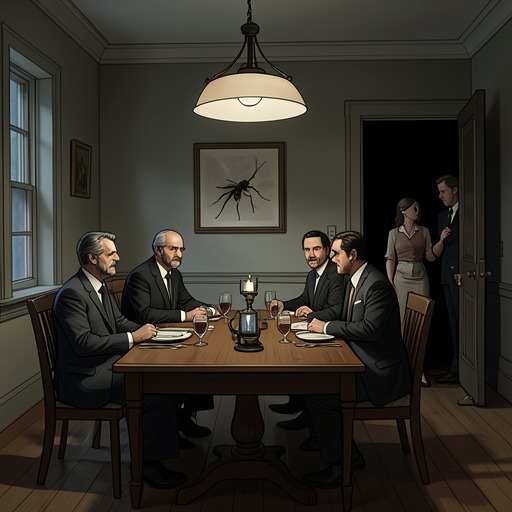
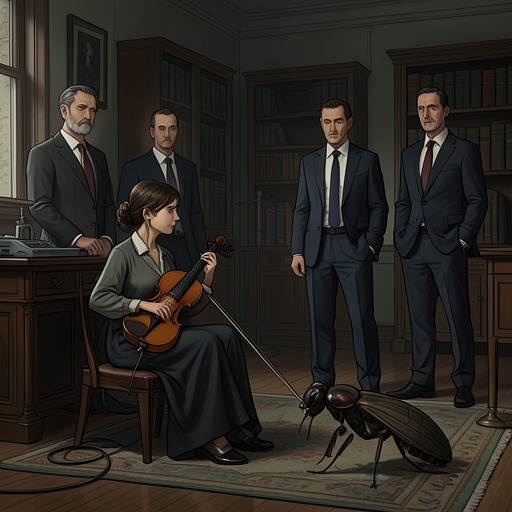
The Violin returns to the center of the narrative when Grete plays for The Three Lodgers. The family, under financial pressure, has taken in the tenants, and their presence has made the apartment a more formal and anxious space. The tenants eat separately in the living room while the family eats in the kitchen, and Mr. Samsa adopts an exaggerated courtesy toward them. When the Violin begins to sound from the kitchen, the three men stop reading and smoking, approach the hallway door on tiptoe, and ask whether Grete will play for them in the room, where they consider it more comfortable.
The family responds as though the performance were a service to be delivered. Mr. Samsa brings the music stand, Mrs. Samsa brings the music, and Grete brings the Violin. Her parents remain standing or sit only where one of the gentlemen directs them, displaying how completely their hospitality has displaced ordinary domestic ease. The Violin is thus placed within an economic arrangement: Grete’s music is offered to the people whose rent helps sustain the household, and the family’s deference makes the performance less an expression of shared pleasure than an act of financial self-preservation.
The gentlemen’s response is notably disappointing. They initially crowd around the music stand to inspect the notes, then withdraw toward the window, speaking quietly and smoking. Their retreat suggests that they had expected entertaining music and have found the performance insufficient for their purposes. The family, by contrast, remains absorbed in Grete’s playing. The Violin creates a sharp division between those who treat music as an amenity and those for whom it carries intimate significance.
Gregor’s Approach
The Violin’s sound breaks Gregor’s habitual separation from the living room. Covered in dust, threads, hairs, and scraps of food, he nevertheless crawls forward onto the clean floor so that he can see Grete. His movement is not presented as a demand for food or physical comfort. He wants to reach her, draw her into his room, and make her understand that he has always intended to send her to the conservatory. In the presence of the Violin, his former plan becomes an urgent attempt at communication.
Gregor’s response to the music also unsettles the category imposed on him. He wonders whether he is an animal if music can captivate him so strongly, and he experiences the playing as a form of nourishment for which he has been yearning. The Violin therefore becomes evidence of residual interior life. His body has become revolting to the family, his speech is no longer intelligible, and his room has become a place of dirt and confinement, yet the music reaches a self that remains capable of desire, memory, admiration, and self-sacrificing love.
His imagined future with Grete around the Violin is tender but also desperate. He wants her to play beside him by her own choice, not because she is forced to care for him. He imagines explaining the conservatory plan and believes she would respond with tears of emotion. The instrument gathers together the brother he was, the sister he hopes to protect, and the domestic intimacy that has steadily deteriorated since his transformation. It offers Gregor one last possible bridge between his inner identity and the family’s perception of him.
Interruption and Rejection
The bridge collapses when Mr. Samsa notices Gregor and the Violin falls silent. The middle lodger points at him and demands an explanation, while Mr. Samsa tries to block the tenants’ view and drive Gregor away. Grete briefly places the Violin in her mother’s lap before hurrying to prepare the tenants’ room. The object that had momentarily concentrated the family’s attention now marks the instant in which their private crisis becomes publicly visible.
The lodgers respond by giving immediate notice and threatening possible legal action over the conditions in the apartment. Their departure follows directly from the performance’s interruption, turning Grete’s music into an economic catastrophe. Gregor’s attempt to approach her has failed to produce recognition; instead, it has cost the family their tenants. The value attached to the Violin shifts from artistic promise and familial affection to exposure, humiliation, and financial loss.
After the gentlemen leave, Grete declares that the family must get rid of Gregor and refuses to call the creature her brother. Her argument is grounded partly in the practical damage surrounding them: the tenants have been driven out, the family is exhausted, and the apartment seems threatened by Gregor’s presence. The Violin does not soften this judgment. It has shown Gregor’s humanity to the reader, but it has not persuaded Grete or the others to recognize him as human. Its failure is therefore central to the tragedy: music enables an inward revelation without creating a language the family can share.
Narrative Significance
The Violin condenses the contrast between economic usefulness and human value. Gregor once supported the household through travelling sales work, and the family accepted his money even as warm affection diminished. Grete’s instrument carries the emotional future he hoped to purchase for her, but after his transformation the family’s attention is redirected toward paid labor, debt, cleaning, food, and the management of lodgers. Music remains, yet it no longer belongs to a world organized around Gregor’s generosity.
The object also reverses the family’s assumptions about Gregor. They see his altered body, his reduced mobility, his hunger, and the dirt in his room; the Violin reveals that these visible conditions do not exhaust his identity. His response to Grete’s playing is one of the last moments in which his former capacity for love takes an outward form. Nevertheless, because the performance occurs before tenants whose rent has become necessary and because Gregor’s appearance converts private suffering into public scandal, the revelation produces exclusion rather than rescue.
After Gregor’s death, the family leaves the apartment together for the first time in months and discusses its prospects in a smaller, cheaper home. The Violin is not heard again in the supplied ending. Its silence is significant: Grete’s music has served as the final medium through which Gregor tries to reach her, and once that attempt ends in rejection, the family’s movement toward a new life proceeds without him and without the instrument’s earlier promise of shared artistic possibility.